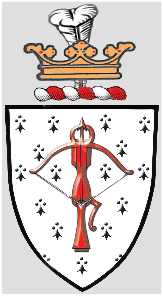
Picture by Rupert Fox from a design by Michael William Alabaster


The Alabaster Chronicle

The Journal of the Alabaster Society


NUMBER TWENTY-FOUR  AUTUMN 2005

Contents


Editorial

by Sheelagh Alabaster - August 2005 

After the Hadleigh weekend to remind us of the best things about our Alabaster Society and a last-minute look at our blossoming website to see what standards the Chronicle should be trying to live up to, the Autumn issue is released onto a waiting universe. Thank you for your contributions and your good wishes.

A great deal has changed in the world of newsletter editing in the last 25 years, we find. At the wrong end of putting this edition together, we asked the right people the right questions about text-wrap and other new dances. Wait for improvements in the next number.

I hope we can run a whole series of reports by our members -- the old ones in their deck-chairs should be brushing up their memories of early family holidays in the sand-dunes of the past when the rain never dampened the fish-paste sandwiches -- and the young ones who still go out and do stuff with their lives should let us know.

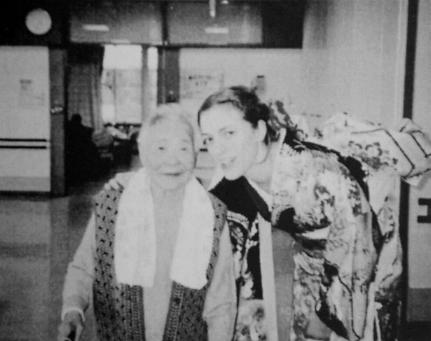
A steady feature could be an adapted Spot the Ball competition. Spot the Alabaster. First one this time is the Japanese story (page 31) Have a look and start guessing. More are planned. Send us suitable photos for the next Chronicle. Deadline end of February 2006.

There will be a subscription reminder going out with this issue, along with the blood, sweat, and tears.

To Contents

An Alabaster Outing to Bethnal Green

Steve Abbott (IIIB) has suggested that Alabasters might like to take part in an outing to Bethnal Green in London to follow up ancestral connections to the area.

He writes:
I was wondering if members would be interested in taking a tour of the area, with a guide to tell us something about life there in the 19th century and the local historical landmarks or where they once stood - for example, the infamous Nichol, the workhouse, and St Matthew`s Church. There are still some surviving Victorian streets which give a flavour of East End life.

A guided tour could be arranged comprising a morning and an afternoon walk on a Saturday, taking in the area round Bethnal Green Museum, Barmy Park, Victoria Park, Bonner Road, Cyprus Road,. There would be a lunch stop and then in the afternoon we could go to Bethnal Green Road, Oxford House, St Matthew's Church, Columbia Road and the Old Nichol .

Another version of the outing could comprise a morning walk and then a coach tour in the afternoon, seeing more of the East End, maybe Spitalfields, the Whitechapel Road, Commercial Road.

If initial interest warrants it there might be the option of helping to organise overnight accommodation if members wanted to visit Petticoat Lane or Columbia Road Flower Market on the Sunday.

Please contact Steve Abbott on 0208 318 1785 if you would like to know more details. Costs will be largely determined by the number of participants.

To Contents


Alabaster Research by the College of Arms

by Tony Springall

At the 2005 Annual General meeting it was decided to create a special projects fund to receive cash raised outside of the normal subscription finances. At the subsequent committee meeting the College of Arms archive was identified as a possible source of information which may enable our family history to be extended back in time. The viability of this approach depended on our ancestors having the right to a coat of arms. I was deputed to approach the College of Arms for them to perform a search of their archives.

I e-mailed the College of Arms in May, giving details of why our family may have had a coat of arms. I received a prompt reply from Peter O'Donoghue, the herald Bluemantle Pursuivant, suggesting that a general search be performed for a fee of £250. The committee agreed to proceed and I received the following report from Peter O'Donoghue on 23 June 2005:

Before I present the report, however, it may be worthwhile to list some of the heraldic terms it uses:

Ermine, the fur, is shown on arms by a white area with distributed shaped black marks.
Palewise means divided by perpendicular lines or orientated vertically.
Gules means red.
Out of means rising from.
Argent means white.
Gorged means circling the neck.
Or means gold.
Azure means bright blue.
Wreath means a roll supporting the crest above the shield.
Enfiling means transfixing.
Tincture means the names given to the fur, colour, metals used in heraldry (ermine, gules, and or).
Erased means that an animal head referred to has a ragged end to its neck.

Thus a shield described as
Ermine a Crossbow palewise Gules
translates as:   A vertical red crossbow on a background of ermine.

The Report

Dear Dr Springall,

Further to my e-mail of 27 May I write to report the results of the research which has been conducted on your behalf in the official registers of Arms and pedigrees held by the College of Arms into the surname Alabaster and its variants, including Arblaster.

The Heralds' Visitations

Between 1530 and 1687, the Heralds visited each county roughly every generation, to oversee the use of Arms, and to record the pedigrees of the gentry. The results were recorded in a series of manuscript volumes, which have been searched for any entries relating to your surname. The following entries were found:

1. At the Visitation of Essex undertaken in 1570 a pedigree of the Allyn or Allen family was recorded. It records that John son and heir of John Allyn of Thaxted, co. Essex, married Elizabeth daughter of Alabastre, and had issue. No Arms for Alabastre were recorded. [Coll Arm Ms H10.52]

2. A very similar entry was made at the Visitation of Essex undertaken in 1614; here the Allen or Aleyn descent has been continued, but the same marriage with Elizabeth Alabastre was recorded. [Coll Arm Ms C15(3).27]

3. At the Visitation of Essex undertaken in 1634 a pedigree of the Scot family includes William Scot of Chigwell, co. Essex, whose will was dated 20 November 1597. He married Prudence daughter and coheir of Edmund Alabaster of Bretts Hall in Tendring [co. Essex]. The Arms of Scot include as eighth quartering the Arms of Alabaster, namely Ermine a Crossbow palewise Gules. [Coll Arm Ms C21.77]

An examination of the Visitation of Staffordshire undertaken in 1566 revealed a pedigree of Bagot; this mentions Maude daughter of John Bagot and of Isabel his wife daughter of John Corson of Essex. She married Richard Alabaster. No dates are given, and there is no mention of the Arms of Alabaster. [Coll Arm Ms H19.103]

5. The College of Arms holds no original manuscript of the 1583 Visitation of Staffordshire. A copy of the original was prepared by Sir William Dugdale in the seventeenth century; it is known to have many errors. Nonetheless is includes a pedigree of six generations, headed by Thomas Arablaster of Longdon, father of Richard Arablaster of Longdon who married Matild [sic] daughter of John Bagot. It ends with Thomas son of George Arablaster of Longdon, alive 1583. The Arms are Ermine a Crossbow palewise Gules. The Crest is Out of a Crest Coronet Or a Greyhound's head Argent gorged with a Collar and ringed Or. [Coll Arm Ms Dugdale + (2).17]

6. Another manuscript copy of the 1583 Visitation of Staffordshire is held by the College of Arms. Here again we find a six generation pedigree headed by Thomas father of Richard Arablaster of Longdon. The Arms however may be blazoned Ermine a Crossbow palewise Gules the Bow Azure. The Crest being On a Wreath Argent and Gules A Feather enfiling a Crest Coronet. A marginal sketch here suggests that the evidence for the Arms and Crest was an old brass seal. [Coll Arm Ms EDN13.51]

7. Another manuscript held by the College of Arms, which contains pedigrees from the Visitations of Oxfordshire and Buckinghamshire of 1574, and of London of 1568, includes a slightly later version of the above pedigree. Seven generations are shown, descending from Thomas Arblaster, father of Richard his son and heir who married Matilda daughter of John Bagot. It ends with the children of Thomas Arblaster and of Anne his wife, daughter of Sir Ralph Egerton. No Arms were recorded. [Coll Arm Ms F1.6b]

8. At the Visitation of Staffordshire undertaken in 1663-4 a pedigree of four generations was recorded. It is headed by George Arblaster of Longdon, co. Stafford, father of Thomas Arblaster of Longdon who married Anne daughter of Sir Ralph Egerton. It ends with the children of Edward Arblaster of Longdon, died February 1657, and of Anne his wife. The children include Edward Arblaster, aged 32 in 1663. The Arms are Ermine a Crossbow palewise Gules. The Crest being On a Wreath A Greyhound's head gorged with a Collar and ringed [no tinctures shown]. [Coll Arm Ms C36.75]

For most of the Visitations, a number of different manuscripts exist. Many are copies which were compiled some years after the Visitation itself, and some of these are held by the British Library and other archives. Transcriptions of a number of Visitations have been published. I enclose photocopies taken from The Visitation of Staffordshire 1583, ed. H Sydney Grazebrook (London 1883), and from The Visitations of Staffordshire 1614 and 1663-64, ed. H Sydney Grazebrook (London 1885).

Funeral Certificates

The College of Arms had a virtual monopoly over the organisation of heraldic funerals in the sixteenth and seventeenth centuries; the records of this activity provide a valuable source as to the use of Arms. These series of records have been searched for entries relating to the surname, and the following entry was discovered:

9. The Funeral Certificate of John Styll, Bishop of Bath and Wells, who died 26 February 1607 at his Palace at Wells, has been recorded. He married first Anne daughter of Thomas Alabaster of Hadley, co. Suffolk, and had issue; his second wife was Jane daughter of John Horner of Clover, co. Somerset. No Arms for Alabaster were recorded. [Coll Arm Ms I16.276]

Registers of Pedigrees

The Visitations ceased in 1687, but since that date a large number of pedigrees have been recorded at the College of Arms. These records have been searched for entries relating to Alabaster, but unfortunately nothing was discovered.

Grants of Arms

In the Tudor and Stuart periods, comprehensive and systematic records of grants and confirmations of Arms and Crests were not maintained. The surviving records of such grants are extensive and varied in the detail they provide: it is however thought that the great majority of grants are on record at the College of Arms. From 1673 the College has recorded the full texts of all grants of Arms. The records of grants and confirmations from the Tudor period to the present day have been searched for entries relating to Alabaster, but no entry for this surname has been found. This would suggest that no grant or confirmation of Arms has been made to anyone of this surname since the records begin.

In the eighteenth and nineteenth centuries it became popular to include clauses in wills requiring legatees to adopt the name and Arms of the testator by Royal Licence on coming into certain properties. This activity led to a large number of new grants and exemplifications of Arms. Again no entry for Alabaster or its variants was found.

Scottish and Irish Records

The records of Matriculations of Arms recorded from 1672 to 1973 at the Court of the Lord Lyon in Edinburgh have been published in two volumes. These were consulted but there is no entry under Alabaster.

The College of Arms holds photographic copies of the records of the former office of Ulster King of Arms, who had responsibility for heraldry in Ireland. The original records passed in 1943 to the Chief Herald of Ireland, who now has heraldic jurisdiction in Eire. A search was made in our copies for entries relating to this surname, but nothing relevant was discovered.

Collections

Besides the official registers of Arms and pedigrees, the College of Arms holds collections of the working papers derived from the heraldic and genealogical practices of a number of past heralds. Some of these series have been searched for relevant entries.

The collection compiled by Ralph Bigland (1711-1784), and his nephew Sir Ralph Bigland (1757-1838), both Garter Kings of Arms, contained no entry for this surname. Nothing was found in the hundreds of manuscript volumes belonging to Sir Charles George Young (1795-1869), Garter King of Arms. The collection of papers derived from the practices of Sir Bernard Burke (1814-1892), Ulster King of Arms, and Sir Henry Farnham Burke (1859-1930), Garter King of Arms, revealed nothing.

The similarly large collection of papers derived from the practices of Sir Isaac Heard (1730-1822), George Beltz (1774-1841), Lancaster Herald and James Pulman (1783-1859), Clarenceux King of Arms, included the following:

10. A pedigree of the Winthrop family includes Bridget second daughter of Adam Winthrop of Groton co. Suffolk. She was born 3 May 1543, and married Dr Robert Alabaster, by whom she had issue four sons and a daughter, who are named. [Coll Arm Ms Pulman Coll. A24.509]

Early Heraldic Records

11. The College of Arms holds a fifteenth century book of Arms known as Writhe 's Book. The Arms of Thomas Arblaster of Staffordshire are given as Ermine a Crossbow palewise Gules [Coll Arm Ms M10.99]. The same manuscript includes an illustration of Arms with no name given, where the Arms are Ermine a Crossbow palewise Gules the Stirrup Or [Coll Arm Ms M10.35].

12. A manuscript in the College of Arms which was also consulted is an Alphabet dating from circa 1520. Here two entries were found giving the Arms of Alabaster or Alabastre as Ermine a Crossbow palewise Gules. [Coll Arm Ms L2.20, and L2.3]

13. British Museum Seals by W de Gray Birch (6 vols., London 1887-1900) contains a reference to the seal of James Arblaster, which is red and may be dated to 1402. It shows a shield bearing the Arms Ermine a Crossbow in pale, suspended by a strap from a forked tree on a mount, within a carved panel. The seal bears the words Sigillum : iacobi : arblaster.

14. A search was also made in the Dictionary of British Arms (T Woodcock et al., London 1992, 1996), a published index to medieval Arms taken from surviving rolls, seals, monuments and other sources. Only two volumes of this projected series have so far appeared. In this work reference is made to the following:

The Arms of Thomas Arblaster are given as Ermine a Crossbow in the Bowditch Mss., a collection of 17th century sketches of medieval seals.

The Arms of Arblaster are given as Ermine a Crossbow Gules by Portington's Roll, temp. Henry VI, and by Randle Holme's Book of circa 1460. The same Arms are attributed to Thomas Arblaster by Peter Le Neve's Book, which dates from circa 1480-1500.

Ordinaries of Arms

Many past officers have compiled alphabets (books of Arms arranged by surname) or ordinaries (books of Arms arranged by device). These may [be] based on a wide range of sources, including printed books, records, and heraldic manuscripts, including those that no longer survive. They are thus a very useful guide to heraldic usage of past times, although they contain no information about properly established rights to Arms. Some of the earlier of these ordinaries have been examined, and the following entries were discovered:

15. Robert Glover, Somerset Herald, compiled a large ordinary in 1584. The College of Arms holds an Elizabethan copy, with additions, of this manuscript, made by John Withie, herald-painter. Here the Arms of Arbalester or Arblaster are given as Ermine a Crossbow palewise Gules [Coll Arm Ms CGY74.208]. The same Arms are ascribed to Arbalaster in an ordinary known as Smith's Ordinary, which was compiled by William Smith, Rouge Dragon Pursuivant, in 1599 [Coll Arm Ms EDN22.32]. An early Jacobean manuscript known as Hare's Ordinary gives the same Arms for Arblaster, and also the Crest Out of A Crest Coronet Or a Greyhound's head erased Argent [Coll Arm Ms R33.85v].

Conclusion

Extensive research in the records of the College of Arms and in a number of manuscript and printed sources has revealed a number of references to the surname. The only entry which makes mention of the Alabaster family of Hadley, co. Suffolk, is the funeral certificate noted at no. 9 above. This makes no mention of the Alabaster family having Arms, although this negative information cannot be taken by itself to indicate that they had no Arms. The fact that the same family do not appear to have been recorded in any Visitation might suggest that they did not aspire to gentry status during this period; this may be contradicted by the evidence of monumental inscriptions which you mention in your e-mail of 22 May.

The majority of entries relate to the Arblaster family of Staffordshire with whom you are no doubt familiar, with some entries relating to East Anglia. It will be clear that the Arms Ermine a Crossbow palewise Gules (with some minor variations) was strongly associated with the surname by early heraldic authorities, due to the punning nature of the Arms. Unfortunately records from the period before the heralds' Visitations record very little, if any, biographical data with the Arms. It is hard therefore to know which person is intended by any particular entry.

I hope that the above is helpful to you in your researches. If you would like to commission heraldic artwork of the Alabaster Arms by one of our heraldic artists, or if you have any further queries, please let me know.

Yours sincerely,

Peter O'Donoghue

Comments on the contents of Peter O'Donoghue's report

The Report is disappointing in that it provides very little obviously relevant to our family and fails definitely to link us back to early Alabaster records. To be realistic, the possibility that the College of Arms archives would extend our family tree significantly back in time was always small. However, the report does provide some information which may assist us in the future.

My comments on the content of the report are as follows:

Items 1-3 relate to the Essex descendants of James Arblaster, ally of the Pastons and escheator (officer formerly appointed to note land reverting to the crown on the death of an intestate owner) of Norfolk & Suffolk in 1463/4. Circumstantial evidence suggests that James Arblaster may link to our family but definite proof is lacking.

Items 4-8 and11 refer to the Staffordshire Arblasters who are very unlikely to link to our family. After further checking, item 13 has been established also as concerning the Staffordshire family.

Items 9 & 10 definitely relate to our family. Both are new snippets but are scarcely revolutionary. Of course, 'Dr Robert Alabaster' is actually Roger Alabaster the father of the poet William and the brother of Thomas of Hadleigh.

Items 12 & 14-15, are less identifiable:
Items 14 and 15 may concern any of the Alabaster/Arblaster families.
Item 12 is more intriguing as it dates to c1520, the year of the death of John Alblaster of Worstead, a member of our family, and it refers to two entries employing the spellings Alabaster or Alabastre. These spellings, as far as I am aware, were only used in East Anglia at this period and, assuming they refer to two separate families, suggest that one of the families is that of James Arblaster - whose descendants started to use the Alabaster spelling - and with the possibility that the other is our family.

I find some of Peter O'Donoghue's comments interesting. For example, he suggests that the family may have been entitled to arms but do not appear in a Visitation as 'they did not aspire to gentry status during this period'. This would certainly fit in with Thomas Alabaster of Hadleigh's character; he does not appear to have aspired to be a Lord of the Manor - despite clearly having had the resources to have done so - and he was described as discrete. I also find it intriguing that Peter O'Donoghue suggests that we might 'like to commission heraldic artwork of the Alabaster Arms'.

Whatever the future usefulness of the report, we are now able tick off the College of Arms from our list rather than continuing to be tantalised by its possible holdings.

Tony Springall 

To Contents


How I Learnt to Start Worrying and Edit a Chronicle

by Sheelagh Alabaster

Hadleigh, 23rd April 2005

How nice, I thought, to be somewhere with no responsibilities and no organising to do. Just roll up whenever, no matter that the trip over from the Stansted turn-off is taking longer than I'd thought; the roads are motor--rally·shaped, and still fairly empty; there is April lining the route and the houses are the colour and texture of Edinburgh Rock, pastel and delicious, with one startling departure into a mellow burgundy.

Oh yes, this is where I parked at the last reunion- OK, and I have just driven in past the same NO ENTRY signs as last time, too. Smartly-dressed adults get out of the car next to mine, Follow them - bound to be Alabasters, they look too happy for a funeral- no hats, so it's not a wedding. Yes, they know the way: Alabasters are Gathering. Quick kiss for a cousin. Now for the ritual queue in the panelled corridor for the loo.

Right, no more gossiping, they are ready to start now.

Sit back, deep breath. Time to do gracious nods to everything the Chairman suggests, OK, this is easy. No siblings yet, but I know some are on their way. Oh good, something subversive to be getting on with during Assembly: the Lower Fourth are quietly folding the raffle tickets on their laps while listening to the rise in postage costs.

How did THAT happen?

The Sibling arrived, and had a word, and suddenly we had Volunteered for Jobs. But at least it`s not Counting Things, or Catering. Cousin Steve thought the Sibling and I between the two of us ought to be able to keep the collective Alabaster punctuation in check and to watch out for deviant spellings. I told him I was all right on most words but had a blind spot for carrots, never knowing where the double consonants need to go. Steve told me an insider secret about my father, Deryck -lovely handwriting, but could never spell lily-of-the-valley. So we both had botanical hang-ups.

To Contents


Archives -- Church -- Kersey Mill

After actually being permitted by the Archivist to touch the ancient parchment our ancestors had written on (quick wry aside from the Knoblochs - "That wouldn't be allowed in Germany." Too right, Valerie. I have been conducting Don Quixote-type run-ins with German bureaucracy all this year), I did a swift scan of the documents for misspelled vegetables and lilies, but my Latin let me down on the racines. I went into the church again, to hear how the massive domed treasure chest had recently been subjected to fiendish tricks from inventive local youth playing magnet-fish with straws and dollops of chewing gum. (This was a slower way of making money than Appleton's crafty marrying-in to a quick fortune: marry a smallpox victim's widow with a tiny heiress daughter and then go on to sue anything in the town that moves). The illuminated search for ill-gotten gains was not done with torchlight, but, in a bid for historical accuracy, the Poorbox was enlightened by means of burning grass, resulting in fusion of small change and incineration of any more generous donations. I gather it was possible to evaluate the loss by counting up the metal strips from the bank·notes.

Our guide in St Mary's also showed us how crucial the length of a wolfhound's winkle-pickers can be for dating purposes. He may have looked like a snub-nosed wooden dragon with carapace wings, but he was, we were assured, just dressed up as a priest. You could tell he wasn't a real priest for he dangled an essential part of a decapitated monarch in his jaws. And his hind feet were cloven.

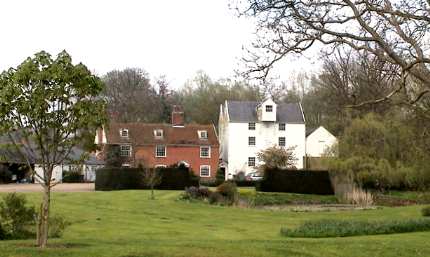
However, neither the monarch nor the wolfhound were directly ancestral, so I moved on to the tour of Hadleigh's Grey Gables at Kersey Mill. Now Kersey Mill had been in Alabaster possession for a decade or so, until Forefather Thomas, strapped for cash (as we had learnt in the morning's lecture by Tony Springall), rather than deciding to embrace a gluten-free diet, flogged it off and went back to spying and wayfaring.

Christine Mellor-Kerr's family has owned the property for about thirty years. The stream for the mill used to have a straight run down from Kersey village, but has recently been moved away from the buildings, (going disconcertingly AWOL when first attempts to divert it were made, but resurfacing later after it had had a chance to experiment, and it now behaves impeccably, feeding a beautiful riverside pond.

Sheltered ornamental gardens now fill out the old stream-bed, The Maltings houses space for communication technology workers- roughly sixty people are presently employed in the complex - more than would ever heve run the place when the mill and maltings were functioning. There are ideas to convert the mill itself, now a tall, listed, timber building that is full of what most families manage to banish to one small garden shed and the cupboard under the stairs. Despite six decades of assiduous roof-leak, only one main beam had gone, and the structure was sound. The stairs up to the upper storey had satisfyingly deep indents for left foot and right foot up through time. The cobwebs are in splendid repair and there is an intrguing walk-in size box labelled "CHRISTINA TO DECIDE".

kerseymillsm.jpg
Kersey Mill in 2005

Repairs to the fabric of the mill would have been carried out in fruit-wood, to withstand as far as possible the danger of fire and explosion (stone-grinding = sparks + flour dust for instant combustion). Christina told us that most mills would have an orchard attached, for this reason. She had been puzzled when she first moved to Kersey Mill to find that the apples growing near to the house were good neither for eating or cooking.

We did not have time to investigate the gym and the various therapies available on the premises for it was almost time for the Drawing of the Raffle; how Laraine managed to get the colour of the tickets so wrong every time she called out one of my numbers I shall never understand.

Other appreciative Comments on the Hadleigh weekend:

Shirley Rowe (IIA)
Once again a very enjoyable weekend due to Laralne's hard work and immaculate planning, not forgetting her band of helpers. A good meal and very pleasant company on Saturday, followed by Roy Tricker's talk, rounded off another memorable day. I would love to hear Betty Alabaster West's talk on her lovely collection of Victorian clothes. I am not sure if the men would be interested - or maybe they would! Finally, my congratulations to Sue Andrews and Tony Springall on the production of their eye-catching book. I'm looking forward to reading it.

TriciaDyer (IIA)
My brother, Colin Alabaster, and I attended our third Alabaster Gathering In April. For the first time, we were able to 'stay over.' We found a B&B In Lower Layham called 'Badgers'. We did not see a badger but they did have a two-day old black lamb In their kitchen. Friday evening saw us dining at the George (a pub once leased by the Alabaster family). We were invited to join a party of six other Alabasters -it was so nice to get to know them - hitherto just names to us.
Saturday - meeting old friends - AGM - viewing memorabilia and other items of interest, --- and the Hadleigh Archivist Sue Andrews. Purchase of the splendid book by the two of them -'Hadleigh and the Alabasters'. In the afternoon we chose to visit Kersey Mill, now fallen into disuse. Interesting and picturesque. Afternoon - tea and raffle. (I won the silver crossbow donated by Stephen Alabaster). Then we put on our 'glad rags' and wined and dined in the Old School Hall. There followed an amusing talk by Roy Tricker. Sadly, we could not stay on for the Sunday activities, but it had all been such great fun and I recommend it to all those who have not yet attended.

More information on Hadleigh and the 2005 Alabaster Gathering can be found here: www.alabaster.org.uk/hadleigh.htm and www.alabaster.org.uk/gathering.htm

To Contents


Roxana Tragaedia by William Alabaster
(written 1592 published 1632)

Olim Cantabrigiae, Acta in Col. Trin., Nunc primum in lucem edita summaque cum diligentia ad castagatissimum exemplar comparata. Cui accesserunt etiam Argumenta.

First edition, 12 mo 106 pp. Early 19th century plain sheepskin (upper joint cracked, lower joint split at the head).

Londini: Excudebat R. Badgerus, Impensis Andrae Crook.

This is the tragedy that had them fainting in the aisles, with a gentlewoman failing distracted in the gardens of Trinity Hall when it was performed ... Are we sure this was not the morning after the May Ball? I tried to get a photo of this but as the book is offered at hundreds of pounds, they preferred for me not to squash it in my scanner.

Ivor Smith has come across an example of this rare early book advertised on the website for Maggs Rare Books, where you can read up about this Latin classic and what Dr Johnson thought of it: http://www.maggs.com/title/EA6602.asp

To Contents


The latest Dictionary of National Biography entry
for Dr. William Alabaster (1568 -1640)

John S. Alabaster (I)

William Alabaster is among many whose entry In the latest (2004) edition of the Oxford Dictionary of National Biography has been expanded and, in his case, a portrait also included. Fortunately, In this well-rounded account some of the small inaccuracies of the edition of 1920 dealing with his conversion and subsaquent imprisonment in the Tower have not been repeated. Furthermore, it contains some welcome new information, namely the quotation of a fulsome tribute by Samuel Hartlib to William in the year of his death.

The author, Francis J. Bremer, has, however, introduced some questionable details. These include reference to William having received the living of Little Shelford, Cambridgeshire, and, in his book, John Winthrop: Amerlca`s Forgotten Founding Father (2003), he has also affirmed, contrary to church records, that William ended his life there as Rector. William's uncle, Thomas Alabaster, is identified as an occasional agent for William Cecil, but since Thomas died In 1592, and the intelligence correspondence dates from 1597, it must be William's cousin Thomas who should have been referred to. Also, after William's escape from the Clink, his London host is given as the Revd. Francis Gerard, rather then Father John Gerard.

Unfortunately, these points tend to undermine the credence to be put on other statements for which no specific references are given, but which might otherwise be considered reasonable conjectures. Examples are: that William actually showed Spenser his Elisaeis in Cambridge in 1591; that Essex organised academic disputations in Cambridge in 1596; that William turned down the living at Brettenham on his return from Caziz and not earlier; and that he became involved in college plots against persons in 1609.

All these points were raised with Bremer in December 2004, and also the above paragraphs were sent to him in draft for comment in mid-May this year, but as yet there has been no response.

To Contents


News from Around the World

Collected by Laraine Hake

As we now have an even better website for the Society,

www.alabaster.org.uk

I have received further Alabaster enquiries through this which I hope will be of interest to other members, so I have included them under this general heading. Come to think of it, I have included emails, phone calls and web enquiries in this section...........I don't think that I have actually included any letters!
Do, please, keep all the communications coming, by whatever medium! I do love to hear from you all - and if you don't want me to use your words of wisdom in the Chronicle, you only have to say! (As ever, everything in italics is my comments - Laraine).

Charles Chaloner Alabaster

Oriole Veldhuis (IIC) 27th December 2004
I was going through pictures on a CD that Myrna had made for me and found this one of Charles Alabaster (left). My mother, Ruth Vane said he helped Emily with the children and gardening, and must certainly have added to the family dinner. Rupert and Ruth were married in 1926. Dad always spoke respectfully of 'Alabaster'. We can see the family dog is interested in the contents of the basket.
The Charles Alabaster here was Charles Chaloner Alabaster (1869-1945), second son of Henry Alabaster ("of Siam"), the eldest son having died in childhood. Charles had been sent to Canada to visit his father's cousin, Percy Criddle, in 1903 and never returned to England. When his mother, Palaccia, died in 1904, he was not given full control of his legacy, unlike his two younger brothers.

 Peter Abbott (IIIB) 4th March 2005
A copy of Sophia Alabaster`s death certificate (8/8/1858, age 21 of 2 Somerset Buildings, BG) is in the post. I've asked around because of the posh writing they had in those days for what was the cause of death. Basically puerperal peritonitis(?) is something about childbirth or effects of maternal mortality. Thanks sadly.
Peter is gradually obtaining the certificates that relate to his immediate branch of the Alabaster family and very kindly sharing copies of them with me. Reading behind the official words reminds us, once again, of the differences between our lives and those of our ancestors 150 years ago. As Peter says, so sad..........


Ivor Smith`s Grand-daughter


Ivor Smith (IV) 28 January 2005
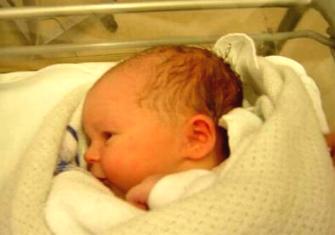
This is my first grand-daughter (right). My daughter Elizabeth gave birth yesterday and this is a picture of Emily just 1 hour old. Born at Harold Wood Hospital, Romford, Essex.

Robbin Churchill, nee Alabaster (IV), USA 7th June 2005
How much we loved, loved, loved our weekend in Hadleigh with the clan. You know that my Alabaster cousin Linda (daughter of Dorothy Alabaster Pless) named her daughter Hadley and now my daughter's friend has done the same. Perhaps we Alabasters are starting a trend in children's names - we just have to help them with the spelling. Back to the weekend...it was such fun and all our thanks to you for pulling it together. From start to finish - it was THE BEST! The only thing I would change was our accommodation. After talking to the group, I now have a fix on the B&B's in Hadleigh so next time, we'll book into something closer to the action. Just a suggestion for the next reunion. We need to talk up the Alabaster Pub night on Friday. It's such a fun, relaxing way to interact with our kin and sets a good tone for the weekend. Betty's display of clothing was really special. Apparently she's on the lecture circuit. I'd love to hear it. Could that be a part of the next reunion? She's so knowledgeable and I find the subject so interesting. There is so much talent in our family. Perhaps we could do a "bring out the Alabaster talent" segment. Speaking of that, I'm mentally planning an article for the Chronicle on my grandfather's engraving prowess. He produced an extensive collection of bookplates which are framed and hanging on a lot of Alabaster family walls. I'll need to enlist family members with digital cameras to make my article complete. Stay tuned but don't hold your breath too tightly. Hope you're having a wonderful summer.
It is always great to get positive feedback on Gatherings, and constructive ideas/criticism too. We will certainly have to persuade Betty to give us a talk next time. As for accommodation, there is a section on the website especially for your recommendations around Hadleigh. Just send the details to Ray Williamson.

Viviana Alabaster, Argentina 10th June 2005
Mucho me gustaría contactarme con mis familiares del Reino Unido, pero no domino el idioma, mi abuelo nació en inglaterra y vinoi a la argentina luego de la gerra de los Boers se llamaba Frederick West Alabaster, y se casó con Alice May Byrne, tuvieron a mi padre que murió en un accidente de auto en 1966. Si podemos comunicarnos les contaré más de la historia de esta familia. Viviana Alabaster.
"I should very much like to contact family members in the United Kingdom but I do not speak the language. My grandfather was born in England and came to Argentina after the Boer War and his name was Frederick West Alabaster, and he married Alice May Byrne. They had my father who died in a car accident in 1968. if we can get in contact I can tell them more about the family."
This was the translation provided by Sheelagh and daughter, Vanessa. It looks fascinating and I did reply to Viviana. Unfortunately I have not heard from her since, but writing this has prompted me to attempt to contact her again.

Alethea Mattock (IV), 14th June 2005
Hi there, I am currently studying my family history for a paper I am doing for my Diploma of Teaching. My mother is Carol Ann Alabaster, daughter of Daniel Roy Alabaster. I am after information on Captain Daniel Alabaster, born 1836, Great Yarmouth, Norfolk, died 1920 at 82 yrs old in Wellington New Zealand. He is my third great grandfather. Captain Daniel Alabaster came to New Zealand at 15 years old in 1854. He discovered Lake Alabaster, Martins Bay, New Zealand. My grandfather's parents were Daniel James Alabaster and Ivy Myrtle Wilkinson.
I was able to share some information about Captain Daniel and point Alathea to the article about him by John Stammers Alabaster in Chronicle No.18, now published on the website too. I passed on Alathea's details to Kelley Videbeck who must be her third cousin!

Mark Collins (IIA), June 21st 2005
I stumbled across the wonderful website the other day and remembered that my great great grandfather was an Alabaster. I am the grandson of Alfred Charles Higgs in Branch II. His father, Alfred Richard Higgs, was the husband of Florence Louise Alabaster.
I replied to this enquiry realising he must be closely related to Norman Alabaster: Florence Louis Higgs, nee Alabaster, was actually the sister of Norman's father, Charles William Alabaster, making Norman and Mark first cousins, twice removed!! But there was more to come.... Mark emailed further, including this:
My mother is going to look through all the family birth/death certificates she has in the loft and let me have more information on the family history. I have also now contacted my Auntie, who was very well acquainted with my grandfather, Alfred. I have copied below a paragraph from an e-mail she sent me today: "I was most interested in your news about the Alabaster family tree. I have now looked at it and found your grandfather together with his sister Florence. The reason I am particularly interested is because I used to know a family of that name back in the 40's and 50's. They lived in Barkingside near to where we lived and there was the parents and their only son Reg. (Reginald) Reg was a pilot in the war and he lost his life. He was a super young man and his parents were, naturally, devastated when he was killed. The parents are long since dead, and the sad thing is I cannot tell you their first names. In those days we were not so familiar -- it was always either 'Mr' or 'Mrs'. I will have another look on the website when I have more time to see if I can find a Reginald. He would have been born in the early to mid 20's. You might like to look as well because it is a fairly unusual name......" I have also done a search for Reg Alabaster and found the following RAF aircrew notice board with someone trying to contact people who remember Reg:
http://www.worldwar2exraf.co.uk/Aircrewnoticeboard83.html
Do you have any knowledge of this part of the family, or are they not part of the same family?
I was particularly interested in this and investigated further.... and was able to reply, "Well, as it turns out, Reginald was quite a close Alabaster relation of yours and mine. He was the gt gt grandson of Charles Henry Alabaster, our common ancestor. In fact, Reginald, like me, was descended from Thomas, brother of Robert, your 3 x gt grandfather. I think that "Mr Alabaster" whom your aunt remembers (actually Alfred Thomas Alabaster married to Emily Cynthia) was the second cousin of your gt grandmother Florence Higgs (nee Alabaster). Now, there IS a small world!"
Marjorie Collins wrote to me directly, "I did know Reg Alabaster and his parents during and after the war. Reg was the close friend of my cousin who was also in the RAF but survived the war. Reg and his parents lived in Barkingside, Ilford, Essex close to where I lived with my parents. They were truly lovely people and were devastated when Reg was killed. He was their only child. They are, of course, dead now, but I often think of them. I was only 11 when the war started, and Reg would have been somewhere between 18 and 20 I should think. My cousin, (Reg's friend) was 7 years my senior.
It is amazing to think that during the war at one point Mark's mother and grandmother lived with us for a while and were completely oblivious to the fact that living just around the corner was a relative of Alfred Higgs (Mark's mothers father and wife of his grandmother)."
Marjorie also emailed the Air Crew Notice Board that was looking for information about the crash in which Reginald Alabaster was killed.
"I notice that you are doing some research into the death of your uncle during World War 2. I cannot be of much use to you but I just wanted to tell you that I knew Pilot Reginald Alabaster who was killed at the same time. I also knew his parents well but they are now deceased themselves. Reg was a very close friend of my cousin Norman Collins who was also in the RAF but he was one of the lucky ones and survived the war. Reg and his parents lived in Marston Road, Clayhall, Ilford Essex."
Robin Dunlop, from Australia replied:
Thank you so much for your email and interest! It is amazing to think that 60 years after this accident I can share details with people like you in another country! I even had people write to me who owned the farm where the plane ended up in. A boy of 13 or so who was helping his father with the harvest when the plane crashed had to help put the flames out...he has written to me with his memoirs. It has been of value to my Mum, Jim's sister. They were never told much about the cause of the crash and I have been able to piece it all together, with the help of witnesses and the RAF archives Accident Report.
If the family of Pilot Alabaster would like to contact me I would be happy to share some of the stories and reports.
I went to Scotland last year and visited the graves at Leuchars and the crash site. All very moving as it was almost 60 years since the accident. I do know that my grandparents wrote to the family of one of the other boys killed with Jim, from the UK. They sent them food parcels through the rest of the War as you had some severe rationing over there and Australia was a bit luckier, also being on a farm it was easier to procure foodstuffs here. I wonder if that family was Reg Alabaster's?
As Reginald was an only child, I was about to write here that we have no contact with his immediate family....but then I had another glance at the family tree. This morning, whilst aiming to get this article together for the Chronicle, I looked again at various emails I have received, including one from a Lyn Millard who contacted me through Genes Reunited last January. I have not heard from her since February, but sent her a brief email this morning suggesting that she looks at the new website. From this second glance at the family tree, I realised that she is closely connected to Reginald, in fact, the email she sent to me in January includes the words "Ellen Elizabeth Alabaster....is my grandmother....I did know my great uncle Alf, who was Ellen Elizabeth's brother...." I have just realised that her great uncle Alf was "Mr Alabaster", the father of Reg the second world war pilot who died in 1944, aged 21.

Query about Elizabeth Alabaster, 22nd June 2005
I am looking for any information relating to Elizabeth Alabaster, who married a James Barnes in the 1830's. Their daughter Hannah, born 17th Nov 1839 in Walpole Suffolk, is my paternal great great grandmother and hence my interest. Many thanks in advance for anything you can provide.
Elizabeth Alabaster was born 5th June 1814 in Bulcamp Union workhouse, and baptised on 9th June 1814, the daughter of Hannah Alabaster. They were discharged from the workhouse on 6 June 1825 when Elizabeth was aged 9. I found the baptism on IGI. The original workhouse records are in Suffolk Record Office. Hannah, mother of Elizabeth, was born 17 April 1788 in Walpole, the daughter of William Alabaster and Elizabeth (nee Kettle). Bulchamp Union workhouse records show that she was admitted there Nov 9 1789 aged 1 year 6 months, discharged April 27 1802, readmitted 20 Oct 1806 aged 18, discharged 3 Nov 1806. Readmitted 22 Dec 1806, aged 18, discharged 14 Oct 1811. Readmitted Oct 26 1812, aged 24, discharged Dec 15 1823. Admitted 1 Aug 1823 (sic) discharged June 6 1825. (I have written (sic) beside my notes at the time, so I can only assume now that that is literally what was written in the book!) Hannah died in Walpole, Suffolk, on 28 May 1853. Cause was Pneumonia, 4 days. She was buried in Walpole 1 April 1853. Hannah had a sister, Lucy. She was born 8 Jan 1790 "born in the house" according to the Union Records, so presumably Elizabeth was pregnant when they entered the house in Nov 1789. She was discharged in 1803 and readmitted in December 1806. Lucy eventually married John Gowing in Blythburgh, Suffolk 21 Sept 1819. William Alabaster married Elizabeth Kettle on 30th January 1788 in Woodbridge St Mary. William was given as a labourer and signed, whereas Elizabeth made a mark. The banns of the marriage say "William Alabaster, minor, a prisoner in the house of correction," so presumably he was a prisoner at Woodbridge on the day of his marriage.
I investigated this further and found in the Quarter Sessions, 16th day of January 1788, Bridewell Calendar,
"William Alibaster (sic) charged on the oath of Elizth Kettle of Trimley St Martin with begetting her with Child is ordered to stand committed until discharged in due course of Law"
Elizabeth was admitted to Bulchamp Workhouse, Blythborough, 9 Nov 1789, aged 35, discharged May 9 1802. She died in Walpole, 22 July 1843 aged 88 "decay of nature" and was buried in Walpole St Mary 26 July 1843. Death certificate states "widow of William Alabaster, agricultural labourer" Informant was Hannah Alabaster, present at death.
William had already died in Bulchamp Union, in 1817, aged 50.

That's it! Not a pretty story on the one hand, but full of human life on the other hand..................its what makes family history so fascinating! It doesn't sound as though their marriage ever had much of a chance, does it!
Have you visited the Alabaster website?
www.alabaster.org.uk
Here you will see that we have traced the Alabaster family way back...............unfortunately no immediately suitable William Alabaster springs to mind, born about 1767, to enable me to place this William into the overall scheme of things! However, I will put our correspondence in the next Alabaster Chronicle, due out September, to see if anybody else in the Society has a suggestion. I do hope that this is of interest to you - and not just depressing! Its all part of the tangled web I guess!
Thank you for the e-mail.
I'm certainly not depressed about what I've read. Historically it puts Bulcamp Workhouse into context. I knew that the local farm labouring community was amongst the poorest in East Anglia and that their fortunes fluctuated with the harvest. I've also read that up until the Poor Law Act of 1835 it was once of the better and more humane of these establishments. I suppose the survival of Hannah, Lucy, Elizabeth, & William shows the benefits of the workhouse system - without it they would almost certainly have died! It also explains why their descendants packed up and left for the bright lights of London in the latter half of the nineteenth century.
I guess theirs is the side to farming that Thomas Hardy didn't write about. Once again many thanks.
I have included this correspondence about Elizabeth and Hannah because of its potential historical interest, rather than there being a link with the Society today. However, any further comments or suggestions would be welcomed!

Malcolm Fowler (IIIA)
I received a call from Malcolm to pass on the sad news that his mother, Valerie (Hetty) Fowler, nee Alabaster, died on 7th July. Valerie was very enthusiastic about the Alabaster family. She had attended several of the Gatherings with obvious pleasure. She will be sadly missed in the future.

Colin Alabaster (IIA) 25th July 2005
My daughter, Sally was married to Simon King at the 'Lost Village of Dode' in Kent on 5th May 2005. Dode is between Meopham and Culverstone near to Harvel or Luddesdown in the middle of nowhere! Sally and Simon married on the 5/5/05 the length of their relationship [years / months / days].

Valerie Knobloch (IV) Germany, 2nd August 2005
I know it is some time now since we returned home from our wonderful experience in Hadleigh....Peter and I had a wonderful time at the meeting and are already looking forward to the next. We know that you and your team worked hard planning our week-end together. Thank you very much. There were so many highlights that it is difficult to say what we enjoyed most. It was our first meeting that we had experienced and as you can imagine we were quite excited to meet up with all those members that we had either written to or who had written various articles in the Alabaster Chronicle.
Already on the Friday evening when we went down to the pub for an evening meal we felt part of the Alabaster family. The atmosphere among the members was so warm and it didn't take long until we too felt part of the group. One person that I was looking forward to meeting other than yourself was Shirley and of course her husband John Alabaster. We had telephoned, written to each other but never met. Shirley and John have helped me with my research on great grandmother Virtue West Alabaster. Also it was great seeing Oriole and Art Veldhuis that we met here in Germany twice whilst Oriole was doing research on her own great-grandmother.
The talk on the latest excellent Alabaster book written by Sue Andrews and Tony Springall was both interesting and exciting. One could almost feel the emotions that Tony Springall had felt whilst doing his investigations on the book. One just cannot forget Roy Tricker and his speech on church towers or was it the excitement and emotions that he spread out amongst us? Without doubt, Laraine, you chose a very interesting person here.
We very much enjoyed the church service on Sunday morning. A real family experience - going to church as a family.
One cannot forget either the selection of historical clothes that Betty Alabaster brought with her. I would have liked to have heard more about this from Betty and not to forget the various Alabaster pieces on the presentation table. Also here I could imagine there could have been a few good stories told here. Having the raffle is a great idea. So exciting really and how fair many of the members were who rejected a second win so that others had a chance. All in all it was a great get-together and we are looking forward to the next meeting in three years` time.
Until then we have the Chronicles to read. How good that we have new editors to do this great job. They already deserve a big thank you in advance. Also Ray Williams (sic) has done a good job on the new Alabaster site. Returning home to Germany my mind went back to the first time I saw the name Alabaster and all what has happened since then. This is about four years ago. It began with my cousin Gladys O'Donnell sending me our grandfather Augustus Edm. Haines' birth certificate to help me find traces of the Haines family. It was here that I first saw the name Virtue Haines nee Alabaster. I remember thinking what a strange name Virtue Alabaster and wondered who she was. During the next days my mind kept repeating the name. I just couldn't forget it. Then instead of looking in internet for the name Haines I looked up the name Alabaster. I even came across a site where someone was looking for information on a Virtue West Alabaster born 1853 in West Ham. Still, I couldn't believe that this was my great grandmother although the name was more than a coincidence. The name stayed in my mind: I just couldn't forget it. One Sunday evening I was on the internet again and came across the Alabaster Society. I can remember reading through the various parts that the Alabaster Society had to offer and discovering the different branches. I was quite inquisitive and decided to open Branch IV and not start at the first branch as one should do.
Well, my heart jumped when I saw my great grandparents' names: John Haines and Virtue West Alabaster. I just couldn't believe my eyes and had to call my husband Peter to confirm what I saw. You remember I wrote to you immediately and you addressed me as 'Dear Cousin'. Then you advised me to write to Ivor Smith as you were very sure that he would be happy to hear from me. Quickly I wrote to him and almost immediately he was on the phone to me hardly believing that I was a great granddaughter of Virtue.
Of course I couldn't keep this all to myself and let my cousin Gladys know of my big find and all too soon cousins that I hadn't heard from for more than 30 or 40 years were writing to me wanting to know more about the Alabaster family and I was more than happy to give them all that I had. My last living Aunt Gladys had even a photo of her 'Grandma Haines' this being of course Virtue and I treasure this photo too. Ivor Smith was able to send me a photo of Virtue's father Henry William West Alabaster.
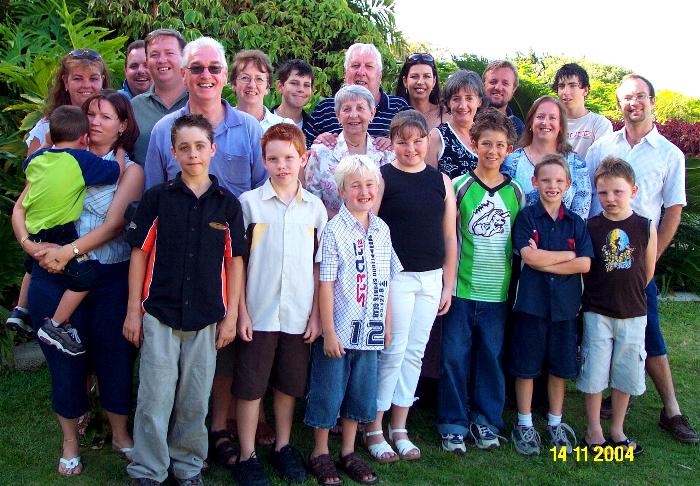
The highlight of discovering the name Alabaster was last year travelling to Australia to meet two of these cousins and their families. I am enclosing a photo of the family reunion that we had in Brisbane last November. I'm sure that Virtue would be more than proud of her many times grandchildren.
So you see Laraine it has been more than worth while discovering the name Alabaster.

virtuerewards1.JPG
Virtue`s Rewards
To Contents


Alabaster Explorers:
Geography Lesson - New Zealand

Ian Alabaster (WoW) refers to an earlier Chronicle article about travel to New Zealand and updates our knowledge bank, surmising on mysterious connections to the lost fortune of the Inca-Maori tribes of the Jewellery Quarter.

Lake Alabaster (Fjordland) c 60 km WNW of Queenstown -- the lake Wawai-i-wuk (now known as Wahai-waka).
On the Pyke River, some 30 km up the Hollyford River (Westland) from the Tasman Sea, a tributary of the Hollyford. Here the classical Maori hewed timber and built craft for use in West Coast trading and rafts for conveying the greenstone (nephrite or jade) they used for tools and ornaments.

After the first European vessel, the cutter Aquila (see note), crossed the Hollyford Bar on the Tasman coast in 1863, Captain Alabaster and Captain Duncan rowed up the Pyke River, reaching Wawai-i-wuk, which they renamed after Alabaster. On the 5th January 1864 the first European vessel on Lake Alabaster, the Maiori Hen, ws launched by a party led by someone called Barrington.

Above Lake Alabaster on its east side is Alabaster Pass, climbed and renamed by Alabaster and a gold-prospector, Patrick Quirk Caples (1830-1904), possibly with a Mori guide. Caples is said to have been the first European to reach the Tasman coast from Lake Wakatikpu, and he may have encountered Alabaster on the Hollingford in January 1863. Alabaster Pass gave access to a track the Maori used for taking greenstone to Lake Wakatikpu. By it, Alabaster and Caples went south, reaching the west bank of Wakatikpu by following the Greenstone River, arriving In Queenstown on 4th October 1883.

Geologist Sir James Hector credits Alabaster and Caples with discovering traces of gold-bearing quartz in Otago, soon to be the location of a goldrush.

Note: Alabaster may not have commanded the Aquila. One account seems to suggest that he merely travelled in her to the Hollyford from the Milford Sound.
Perhaps Alabaster discovered the gold and let our relatives at Alabaster & Wilson Ltd. (Goldsmiths) into the secret whereabouts of the mine, hence our gold Crossbow Brooches.
At this point Ian is sent off to write 100 lines about not letting his imagination run away with him.

To Contents


Another Intrepid Alabaster
Olivia Alabaster (IIA) in Japan

Since my first night in Japan, when I walked around Tokyo with friends I`d met for the first time that morning at Heathrow, I already had a feeling that I was going to love my next 6 months. Huge skyscrapers twinkled all around us as we darted in and ot of izakaya, traditional bars where business-men normally go for a drink and snacks before making it home, drinking Asahi beer and eating little doughy balls of octopus. We wanted to try everything immediately -- you can get Asahi in the UK -- to understand the cuisine quirks of our newly adopted home, so sitting down at our next izakaya we ordered a bottle of warm sake and a plate of sashimi. Preying on naive foreigners who knew only "sake", "sashimi", and "please" at this stage, they brought us the most expensive bottle of sake and the bloodiest plate of raw tuna I came across during my whole time in Japan, which at least warned us we needed to learn some Japanese fast!

The next day my partner, Rhiana, a girl the gap year organisation paired me with, and I took the shinkansen, or bullet train, to Osaka, soaring along the coast at about 180 mph, endless white -roofed villages flashing past the window, and mountains in the background.

We were picked up and taken to the town of Mihara-cho, and without even a chance to put down our bags we were greeted by hundreds of the elderly home residents, shaking our hands, bowing to us and pressing flowers into our hands. After two days of relaxing in our tiny apartment on the complex we were straight to work from 9-6 pm, five days a week, assisting the care staff.

In the first week we found ourselves dressing up as babies with the President of the Elderly Home to do a dance for the residents; visiting our first onsen, where hundreds of seemingly oblivious naked women walk around a series of indoor and outdoor hot springs and baths; being introduced to the Mayor of our town; experiencing two earthquakes which made our little second-floor apartment sway back and forth: and learning to make and pour vast amounts of green tea for the elderly residents. We were also shown to the Alzheimer`s ward of the hospital, which although initially the most shocking, turned out to be where we were to spend most of our time. Having never met anyone with Alzheimer`s before it was overwhelmingly saddening to see Kibota-san walking around crying, looking for her twin, who, unknown to her, was hundreds of miles away, to see Takahata-san looking in her 1995 day diary to see what she was supposed to be doing that day and then getting angry with herself and upset when she realised something did not make sense, Hiyashibi-san talking to his doll as if it were his grandchild, and to see them all have family visits and yet not know whom they were talking to. But I also loved being in this area of the hospital the most. On other shifts I would be nappy-changing, feeding and bathing the patients, and although I quickly got used to this as well, being able to spend time actually talking to the patients, playing games with them, drawing with them, recreational activities my Japanese colleagues had little time for owing to endless reports that needed to be written, were so enjoyable, and, cheesy though I know it sounds, rewarding. Being able to distract them from whatever was going on inside their heads for even a few minutes with a clapping game, singing a song, or reading a book was so lovely to be able to do. And, as you might have presumed, I was lucky enough to pick up Japanese very quickly, owing partly to my initial evening study work I forced on myself, and also because I honestly think it is a fairly easy language to pick up.

Outside work we experienced the crazy life of the Japanese youth in the centre of Osaka: Namba, where all fashion rules are forgotten and anything goes. We saw whole shops dedicated to dog-clothes, record stores open until 5.30 in the morning, people selling kittens and puppies on street corners, and gigolos walking around advertising themselves.

We were taken to Japanese tea ceremonies, to Noh theatre, and hiking around countryside and villages which looked as if they had not been touched since the feudal era, geisha-in-training dances in Kyoto ... we were invited on homestays to experience traditional Japanese family life, and on one occasion were fed, in a single breakfast sitting, salmon fillet, a bowl of rice, a bowl of beans, fried egg, toast, apple, bacon, sweetcorn soup, green tea, juice and coffee. At New Year some colleagues dressed us up in kimonos for the whole day which was amazing to try out, and the residents loved seeing us in them. We were even taken to the local Buddhist temple to pray, and walking along the little cobbled paths in our kimonos we received some rather shocked looks as we were the only foreigners for miles around.

We were allowed two weeks` holiday in late January, when Rhianna and I travelled down to the island of Shikoku. We walked through snowy forests, crossed vine bridges over icy rivers, and there we stayed in a Youth Hostel run by a Buddhist monk and his wife in the top of a mountain. It was so cold we could see our breath as we fell asleep at night. Then we moved on to Hiroshima, which was as upsetting and shocking as you might imagine. I feel very lucky to have had the chance to visit the Peace Park there, and cannot believe how ignorant I was before I went. We went to the tiny island of Miyajima (pictured, left) which is over-run by wild deer and which has a floating temple gate in the water
We spent Chinese New Year in the Chinatown at Kobe and then returned back to work for a few weeks. Saying goodbye to the patients whom I had come to love as family was one of the hardest things I have ever had to do, and seeing them cry as well was awful. Of course I want to go back to Japan but some of them, being in their 90s and even several past 100 might not even be there, let alone remember me.

When I returned home my Dad asked me the three things I missed most about Japan. Firstly, it was the respect for the environment and for each other which I think is missing from Britain. On a small scale they will not drop litter or put each other down in the way that I think we do here, and the rate of all large-scale crime is extremely low. I think on an international level the Japanese seem more diplomatic and peaceful than their western counterparts. Secondly, and leading on from the first point, was the general level of happiness and contentedness which I believe is common among the Japanese. They work tremendously hard, but they enjoy their work and encourage each other to do so. Morale is high. And thirdly, I missed the weather and the beautiful changing seasons in Japan. Sadly I was not there for the sakura, or cherry blossom, but I loved the crisp autumn, with its momoji, the changing colour of the leaves, and the bright fresh winter.

Japan is a truly wondrous place with quirks and oddities around every corner, most of which are hard to explain to someone unfamiliar with the place, and is so rich in culture and eccentricities that I think it would be extremely hard not to fall in love with the Japanese and their country.

To Contents


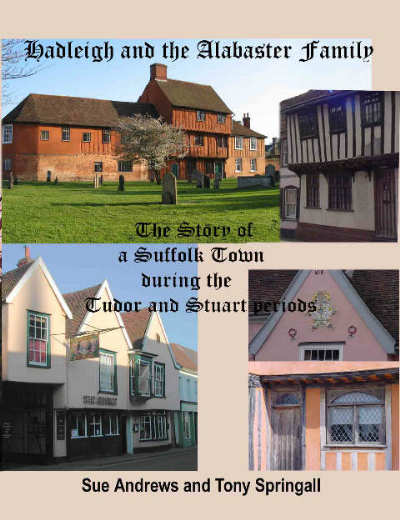
bookjacket1.JPG

A new Book

'Hadleigh and the Alabaster Family'

by Sue Andrews and Tony Springall
(hardback, 384 pages, illustrated, £14.99 +p&p)

This may now be purchased by overseas members from The Federation of Family History Societies' sales website:

http://www.genfair.com/shop/pages/ala/page02.html

The advantage for overseas members is that they are able to pay for the book in their own currency. Alabaster Society members living in the UK may also purchase from this website but, as profits from sales are shared between the Alabaster Society and the Hadleigh Archive, there is a financial benefit for the Society if they continue to purchase the book from Sue Andrews at 17 Manor Road, BILDESTON, Suffolk. IP7 7BG , price £14.99 plus £5.00 p.& p.


To Contents